> ## Documentation Index
> Fetch the complete documentation index at: https://docs.flowx.ai/llms.txt
> Use this file to discover all available pages before exploring further.
# Build and change apps with the Developer Agentic Harness
> Describe a change in plain language and the FlowX Designer's AI agent surveys your app, plans the change, and builds it on its own branch for your review.
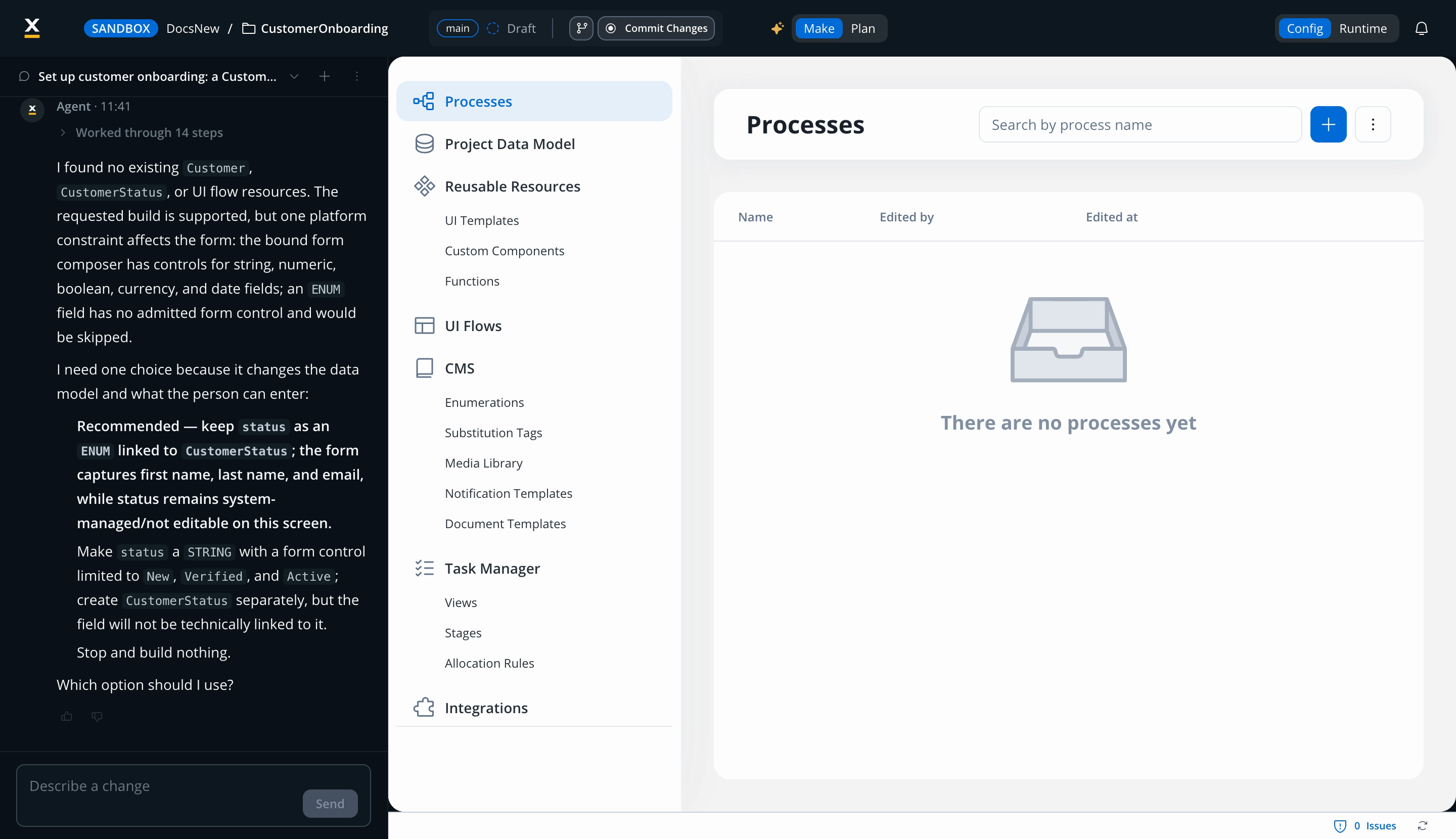
The FlowX Developer Agentic Harness is an AI agent in the Designer that builds and changes apps from natural-language instructions. You describe the outcome you want, for example "set up customer onboarding: a Customer data type, a CustomerStatus enumeration, and a UI flow with a form that captures the customer details", and the agent surveys your app, drafts a plan, and carries it out on a dedicated branch. You hold every gate: you give the plan the go-ahead, review each operation before it runs, and decide when the branch merges and when a new version is served to users.
***
## How it works
**1. Open the agent rail**
Inside your app, select the **Build with AI** toggle (the sparkle icon) in the header at the top of the Designer, or press **⌘K** (**Ctrl+K** on Windows and Linux). The agent opens in a chat rail on the left side. The rail header shows where the conversation writes, for example **Writes to** `customer-onboarding` · `main`. Each conversation is a separate thread: open the conversations list to search earlier threads or start a **New conversation** for a new piece of work. You can also open the agent from organization and workspace pages, see [Can I use the agent outside a project?](#can-i-use-the-agent-outside-a-project).
**2. Describe the change**
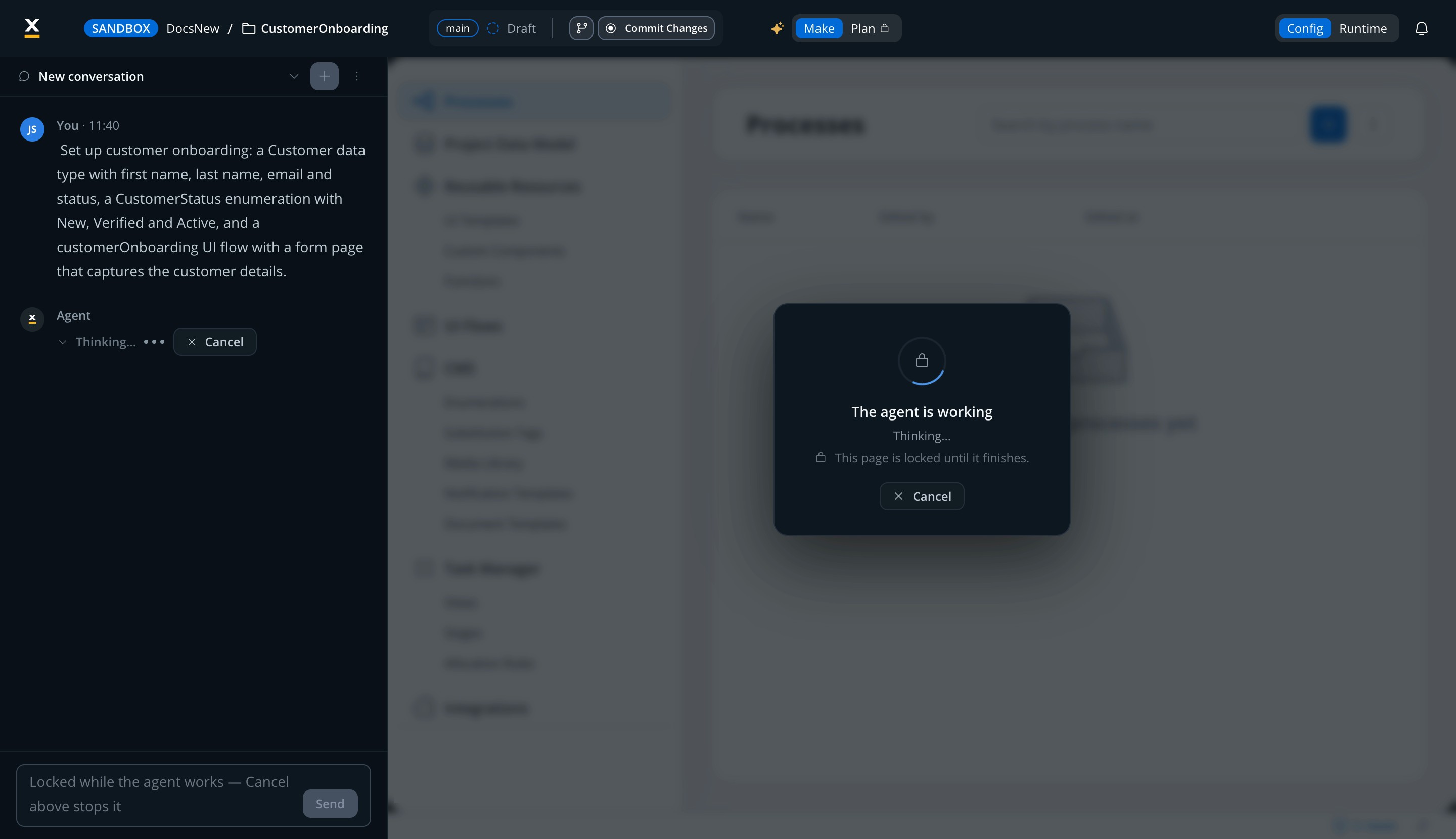
Write what you want to build or modify in plain language. The agent first surveys the app so it works with your real resources and names rather than guesses. While it works, the page is locked and shows its progress. Select **Cancel** at any point to ask the agent to stop: once the stop is confirmed, the conversation says *Stopped. Nothing was saved.* If the run can't be stopped, it keeps going and the conversation shows it as still running.
**3. Answer its questions**
When a material decision is open, the agent asks instead of guessing. Questions come with selectable options, including a recommended one, and you can always answer in free text.
**4. Give the go-ahead**
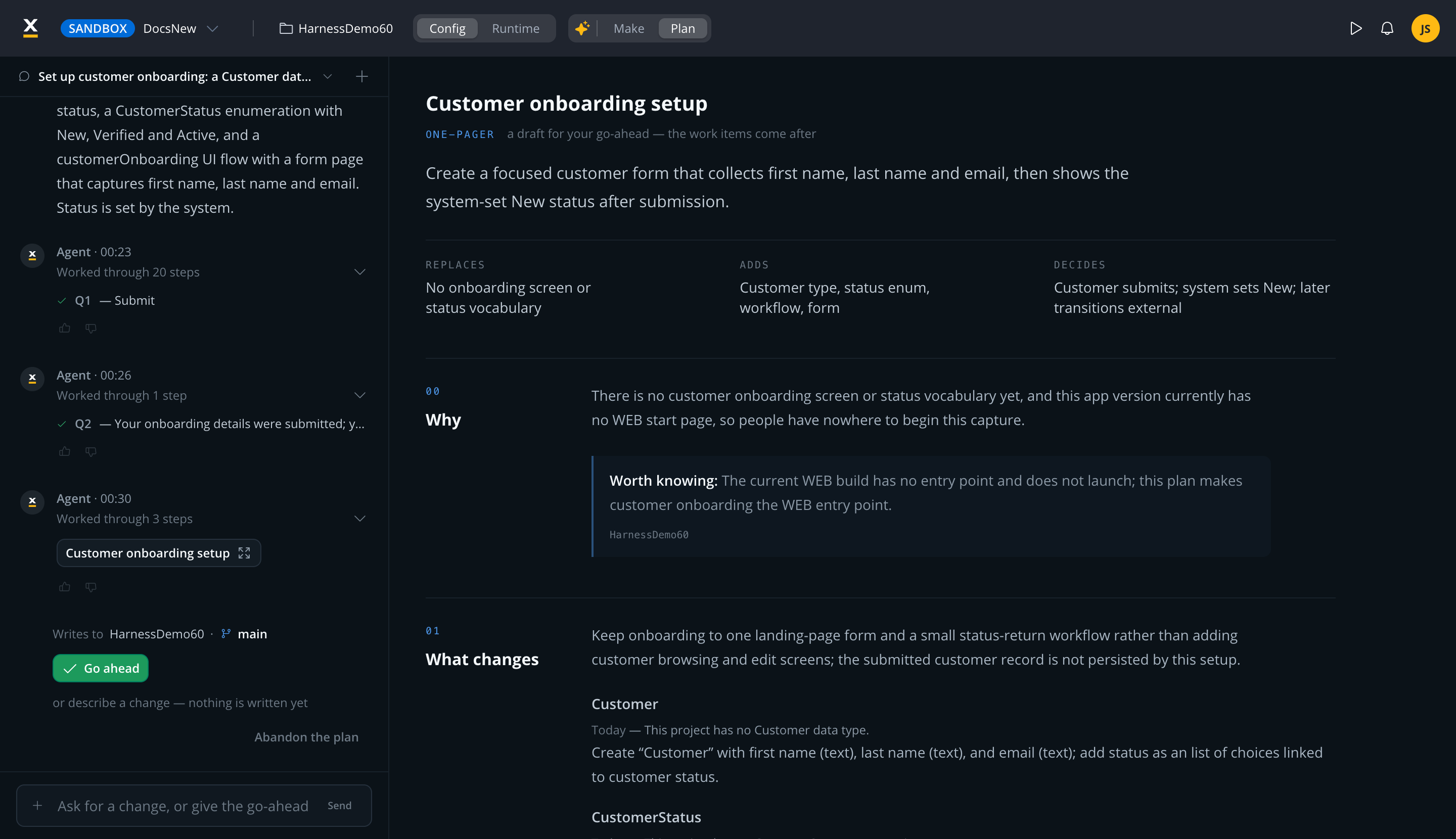
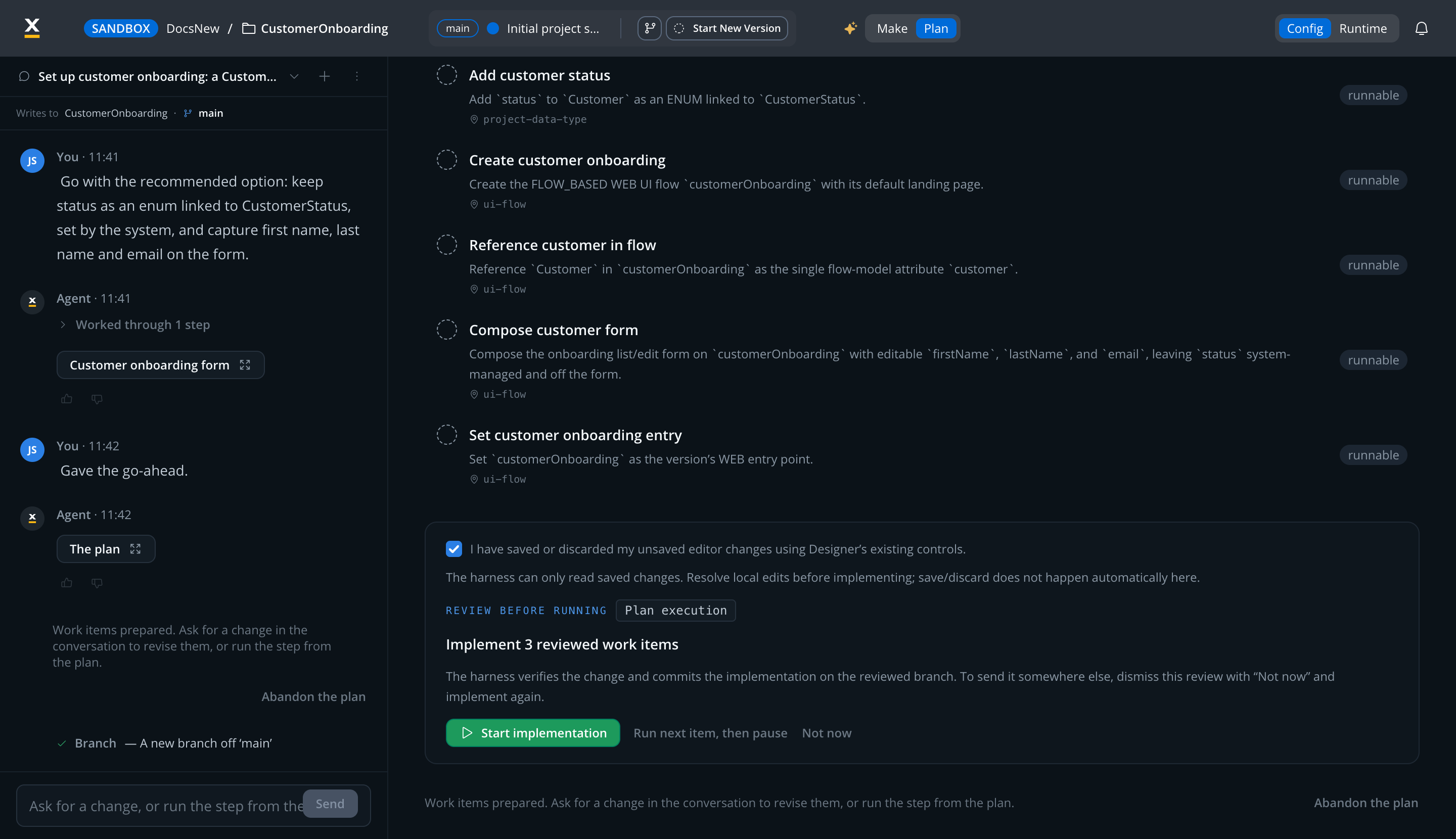
The agent presents a one-pager: why the change, what changes, and the decisions it settled on. Select **Go ahead** to have the agent prepare the work items, or describe a change in the conversation instead. Nothing is written to your app at this point. Your go-ahead also lets the agent make small adjustments that stay within what you approved, see [Changes to a plan during a run](#changes-to-a-plan-during-a-run). On FlowX.AI 6.0.0, a **Let the agent adjust within this plan** checkbox on the one-pager turns these adjustments on or off. If the agent still sees open questions, the button reads **Go ahead anyway**.
**5. Choose where it runs**
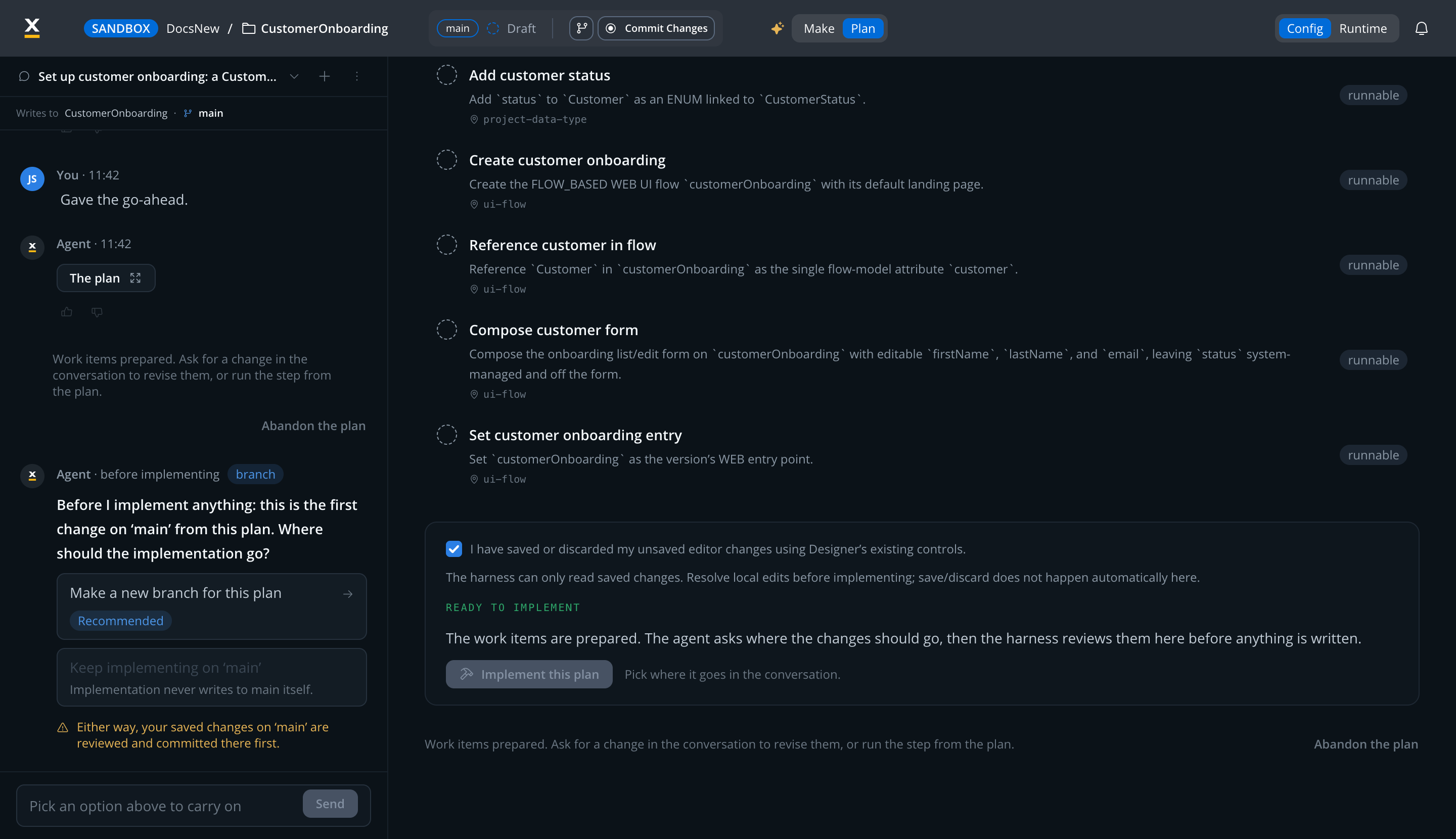
The prepared plan lists its work items with their constraints and the resources each one touches. Select **Implement this plan**, and the agent asks in the conversation where the implementation goes: keep implementing on the current branch, or **Make a new branch for this plan**. On a branch other than main, keeping it is the recommended option. On main, a new branch is the only option, because implementation never writes to the main branch itself. Either way, the review that follows shows any saved changes on the current branch, and nothing is built until you confirm committing them there.
**6. Review before running**
The agent can only read saved changes, so save or discard your open editor changes first, then, for a plan without stories, select the checkbox **I have saved or discarded my unsaved editor changes**. The review pane lists the reviewed work items with the full content of every operation. Select **Start implementation** to run the plan, or **Run next item, then pause** to run one item at a time. When saved changes need committing first, the buttons read **Commit changes and start implementation** and **Commit changes and run next item, then pause**. To send the work to a different branch, select **Not now** and select **Implement this plan** again.
**7. Review the result**
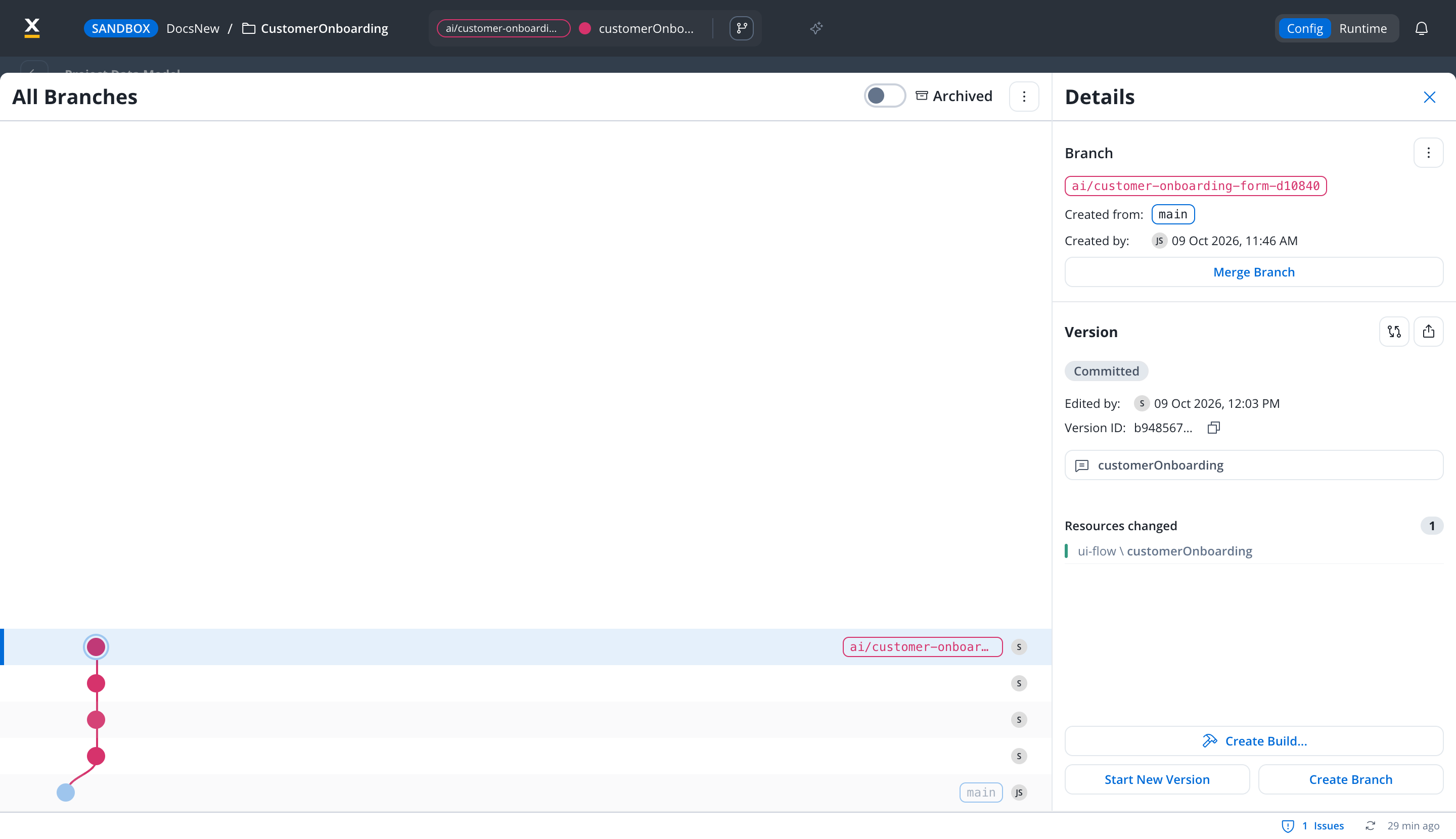
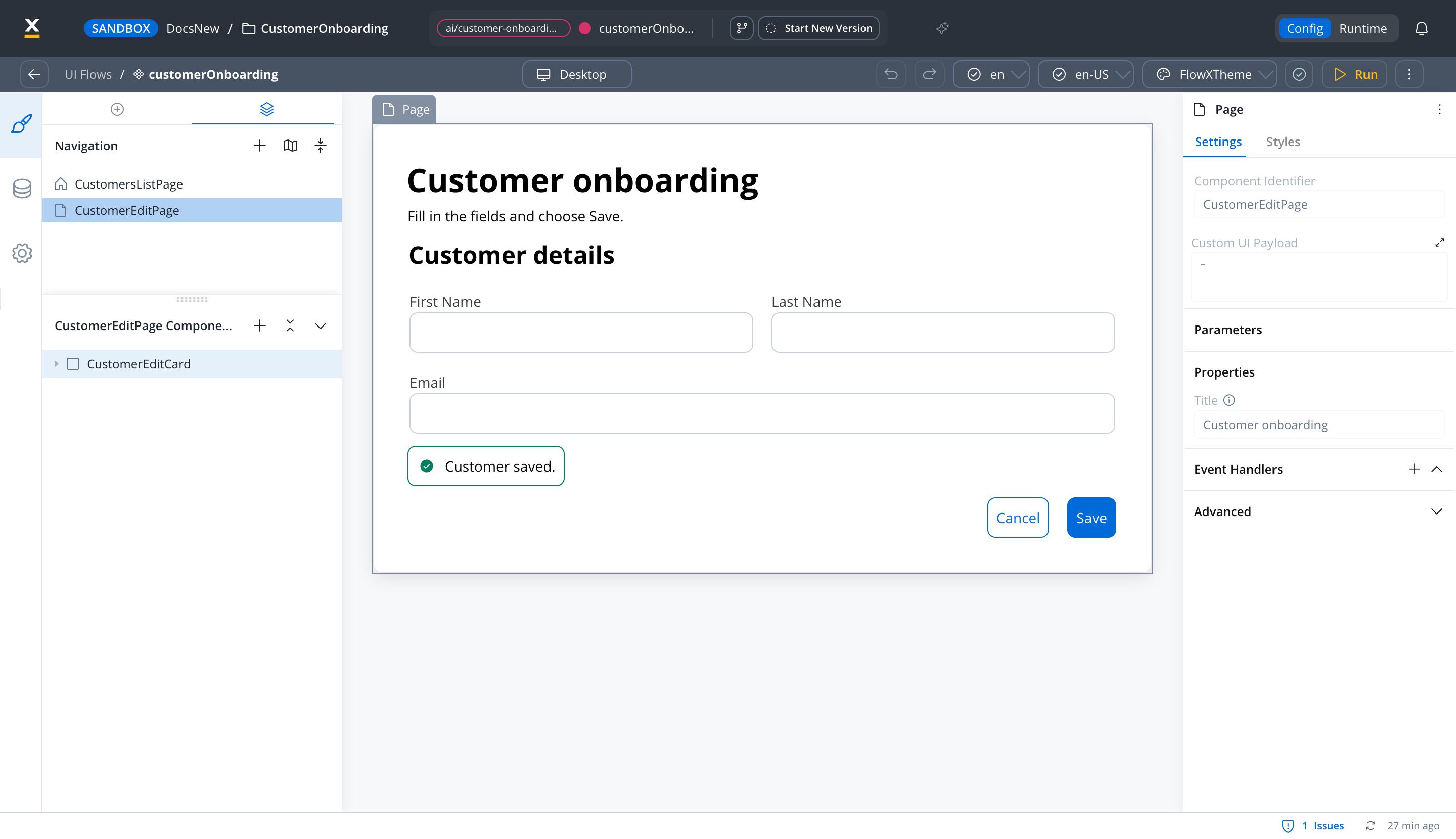
The agent carries out the plan on its own branch, verifies each item, and commits it there. The plan panel tracks progress, for example **3 of 6 implemented**, and the conversation reports each step as it completes. When the run is done, review the committed version and its changed resources on that branch. **Open the branch** takes the Designer to the latest version of the branch the plan wrote to, from wherever you are, for example after the agent made a new branch or after you moved to another branch. When the built version has a web entry point, a process or a UI flow, the conversation also offers **Test run**: it opens that entry point on the built version so you can try the change before you merge. Test run needs permission to read process instances for a process, or UI flows for a UI flow. Merge the branch when you are satisfied. Your users are untouched throughout: the app keeps serving the served build until you serve a new version.
***
## Make and Plan views
The **Make** | **Plan** toggle appears next to the **Build with AI** toggle while the agent rail is open. It switches the main area between your app content and the agent's plan panel. While the agent is working, **Plan** shows a lock icon.
* **Make** shows the app itself: your processes, UI flows, templates, and the rest of the Designer, including any changes the agent has made.
* **Plan** shows the current plan: the one-pager for your go-ahead, then the work items with their constraints, what each one touches, and how many are implemented. Plan unlocks once the agent has drafted a plan in the current session.

***
## What the agent can see and change
The agent works only with **design-time resources**, the things you author in the Designer. It can survey every resource type in your app, including processes, UI flows and views, workflows, systems, project data types, reusable functions and UI templates, enumerations, themes, media files, and document and notification templates.
Changes it can make include:
* Creating and editing **processes**: adding and renaming nodes, wiring sequences and gateway conditions, attaching business rules, notification steps, and workflow calls.
* Creating **UI flows** and binding components to your data model.
* Creating and editing **project data types** and their attributes.
* Creating **workflows**, including conversational workflows that back chat-based UI flows.
* Working with **libraries**: showing which libraries your app uses and what a library change reaches, adding, updating, or removing a library dependency, and reusing a library resource instead of building it again. Removing a dependency, or updating it to a build that drops resources, is refused while your app still uses those resources. The agent can also roll a library change out to the apps that use it: you try the change in the apps you choose, then move them to the library's release.
* Turning **Use in Reporting** on or off for a process, UI flow, or workflow, and setting **Use in Reporting** and **Sensitive data** on the fields of its data model.
For focused generation work, the agent hands tasks to specialized agents: one drafts data models, enumerations, and templates, one writes code such as business rules, expressions, and reusable functions, and one lays out UI. They only return proposals. Nothing they produce reaches your app except through the plan you approved.
> [!NOTE]
>
> The agent never touches runtime data. Process instances, UI flow sessions, and other runtime records are refused by design: they are your users' in-flight journeys, not app definitions.
***
## Safety and review
* **Never on your main branch.** Implementation runs on a dedicated branch the agent creates for the plan, or on another branch you choose. Implementation on the main branch is not allowed, and the agent merges a branch only when you ask and confirm the merge. See [Merging a branch](#merging-a-branch).
* **You approve before anything runs.** The agent executes a plan only after you give its one-pager the go-ahead, choose where it runs, review the exact operations it will perform, and select **Start implementation**.
* **You approve changes to a running plan.** Changes beyond what you approved wait for your review, and work items that already ran stay as they are.
* **Verified before committed.** The agent validates its change and commits it on its own branch, where you review the version and its changed resources like any teammate's work.
* **Runtime stays untouched.** The app's launch link and its users keep the served build until you serve a new version. Runtime data, such as process instances and UI flow sessions, is refused by design.
* **Guarded destructive operations.** Deleting a process, for example, is refused while the process has running instances, is referenced by a subprocess or navigation, has start timers or triggers, or is still in use. The agent does not clean these up to force a delete through.
* **Cancel at any time.** A confirmed stop ends the run cleanly, and the session can be resumed later. A run that can't be stopped keeps going, and the conversation shows its progress.
* **Exact wording is preserved.** Names, conditions, and scripts you give the agent are used verbatim. If something needed is missing, the agent asks instead of inventing it.
### Merging a branch
When you ask the agent to merge its branch, it plans the merge as a separate step after the work it merges has run. By default it merges into the branch it was cut from; name another branch to merge there instead.
* **You confirm the merge itself.** The merge's review states what it changes: the destination branch changes for everyone, is locked while the merge runs, and the merge can't be undone once it completes. The agent merges only after you confirm that review. Approving the plan doesn't count as confirming the merge.
* **Conflicts are your call.** When the branches conflict, the agent asks you about each conflict, one at a time, with a recommended answer. Pick a side, or cancel to discard the merge.
* **Conflicted merges are checked first.** The agent makes a conflicted merge on a separate check branch, validates the result, and runs each process, workflow, and UI flow the conflicts touched. The destination changes only if the result adds no new errors. The check branch stays in the branch graph.
* **Other makers' work is safe.** When someone else has work in progress on the destination, the agent refuses the merge instead of discarding their work.
***
## Changes to a plan during a run
Plans can change after you approve them, either because you ask for a change or because the agent finds that the remaining work needs to differ.
* **Within what you approved:** the agent adjusts the plan and tells you in the conversation, for example "The agent adjusted the plan within what you approved — now v2."
* **Beyond what you approved:** the run pauses and the rail shows **A change to the remaining items is waiting for your review**. Select **Review the change** to open it in the plan panel.
* **A change to what the plan is for:** the review warns that approving it gives the description the go-ahead again.
* **A change you ask for while the plan runs:** it is queued, the run pauses after the current item, and you review the change there.
The review card, **A change to the plan**, shows the version change (for example `v1 → v2`) and every remaining item. Items already run stay as they are, and the rest run as shown. Select **Approve the change** to continue the run with the new version, or **Not now** to keep the plan as it was.

***
## Entry points, handovers, timeouts, and repairs
* **Entry point only with your consent, and no serve.** A plan sets or replaces an entry point only when you asked for it yourself, by answering the agent's question or by changing the plan's description before you confirmed it. A line the agent wrote on its own doesn't count. When a plan ends on a version with no web entry point, the agent suggests one, the resource that opens the most of what the plan changed, as its own step. Setting it changes only the plan's branch. The plan never serves its work: it ends with a note that the work is built on its branch and not merged into main. Merge the branch, then serve the new version when you're ready.
* **Handover buttons.** The agent can add a button to a user task that starts another process with prefilled data, either in this app or in another app's active build.
* **Waits for a workflow reply time out.** When the agent builds a screen that waits for a workflow's reply, it adds a timeout and an error route so a lost or failed reply doesn't strand the user. The wait defaults to 15 minutes, and the route goes back to the nearest user task with nothing written, unless you name another step. The preview states both defaults. A step that already has a timer or error event keeps it as it is.
* **Configuration errors are reported.** A work item that changes a process reports the new configuration errors it leaves, then completes.
* **Failed runs are repaired within budget.** When a step fails at run time, the agent reads that run and proposes a repair. Repairs of a step count across plan versions, so a repair you confirm after a plan change still spends the step's budget.
* **A platform that doesn't answer pauses the run.** When the platform doesn't answer a step, even after the agent waits and tries again, the run pauses instead of failing, and the conversation names the step that had to wait. Select **Resume remaining items** to try again: the agent first checks whether that step already went through, so nothing is applied twice.
* **Small edits skip the one-pager.** When you ask for one exact change, such as renaming a resource, the agent drafts it, checks it against your app, and applies it straight away, then tells you in the conversation what changed. It stops for you to select **Start implementation** first only when the change can't be undone, when it affects other resources or another app that use what you're changing, or when the agent can't check what uses it. On FlowX.AI 6.0.0, every small edit waits for **Start implementation**. When the name you gave matches more than one resource, the agent first asks which one you mean. A larger change, or one the agent can't check up front, goes through the one-pager and the plan as usual.
***
## How does a plan with stories run?
Some plans split the work into stories, each a slice of the app you can try on its own. A plan with stories is implemented one story at a time, so you can check each slice before the next one starts.
* **Open a story** to see where it sits in the plan (for example **Story 2 of 5**), **How to test this story**, **What I need from you**, what was decided, **What this story touches** (a forecast that may change when the story starts), and the stories it depends on.
* **Implement the next story.** Only the next story in line offers **Implement**. Select **Implement this story**, review its operations, and run it. When saved changes need committing first, the button reads **Commit changes and implement this story**.
* **Follow the progress.** The plan counts implemented stories, and each implemented story shows the commit it landed as. The conversation reports each story as it's built, implemented, waiting for you, or stopped.
* **Run the rest.** Once a run exists, **Implement the remaining stories** runs every story still open. When a story needs an answer from you, answer it to continue. After a reload, choose how far to continue: **This story only** or **The remaining stories**.
***
## How do I comment on the running app?
Point at what you want changed instead of describing where it is. While the agent's panel is open on a running UI flow or process, select **Comment** in the header, beside **Config** and **Runtime**.
**1. Pick a component**
Select a component in the running app. Use the breadcrumb to pick the level you mean, for example the whole card rather than one field inside it.
**2. Say what should change**
The comment box quotes the component. Type what should change and select **Send**, or press Enter. Shift+Enter adds a new line.
**3. Continue in the conversation**
The comment goes to the agent with the component attached as context. It joins the open conversation when that conversation writes to the run's branch or has no target yet. Otherwise it starts a new conversation, and a run on the main branch always starts a new one.
Comment mode works only on a run started from the latest version of its branch: the work in progress or its latest commit. On any other version the button is unavailable and its tooltip reads **Comments are available on the latest version of** the branch. Select **Comment** again, **Leave comment mode**, to turn it off.
If you pick another component while a comment is unsent, the Designer asks **Discard this comment?**. If the component leaves the screen, the box says **This component is no longer on screen**.
***
## What happens when the agent asks to read another project?
The agent reads and writes inside the conversation's write target. When answering needs more, for example another project in the workspace, it asks first with a **Read from** card that names what it would read and why. The access is read-only: nothing there is ever written.
* Select **Allow for this conversation** to let it read. The access lasts for this conversation until it goes idle.
* Select **No**, and the agent answers from the write target alone.
To see or remove access you granted, open the **reads** link on the conversation's rail and select **Revoke**. Revoking drops what was read from the conversation right away.
***
## Can I use the agent outside a project?
Yes. The **Build with AI** toggle also appears on organization and workspace pages, so you can start a conversation before you open a project. Each page level has its own permission, and one level never stands in for another:
| Where you open the agent | Permission | Default roles that have it |
| - | - | - |
| Organization pages | `org_aiagent_edit` | Organization admin, Organization owner |
| Workspace pages | `wks_aiagent_edit` | Workspace admin, Workspace user |
| Inside a project | `aiagent_edit` | See the [roles and permissions matrix](https://docs.flowx.ai/6.x/setup-guides/access-management/roles-permissions-matrix.md) |
A conversation outside a project can read projects but not change them:
* **Ask about a project by name.** The agent checks that you can read the project, then reads it as you, read-only, at its last commit on the main branch. If the name matches no project you can read, the agent says so and offers projects you can read instead.
* **To change a project,** open the project and work from there.
* **Attaching files** needs a project, so it isn't available outside one.
***
## Sessions
A conversation belongs to you and stays open as you move around the Designer. It writes to one project and branch, set by the first change you confirm, and the rail shows that target after **Writes to**. Opening other pages adds context but never moves the target: on another project, the rail notes that the conversation still writes to the first one. A conversation also keeps the language you first write in: the agent's replies, previews, refusals and stop messages use it, and quoted text and code stay as written. On FlowX.AI 6.0.0, the agent's fixed messages, such as previews, refusals and stop text, stay in English. A paused run waits at a verified item boundary: select **Resume remaining items** to continue, or **Run next item, then pause** to step through the rest. When a failed step stops the run, the plan keeps its run card and the rail tags it **run failed**. The rail and the conversations list tag a plan by how its run stands: **run paused** or **run failed** while the run is open, **built — waiting for your choice** when every item is built and the agent waits at the plan-end offer, **implemented** once the run completes on the plan's branch, and **built — ready to publish** once that branch is merged. On FlowX.AI 6.0.0, a built plan waiting at the plan-end offer reads **run paused**. When every item is implemented, **Finish the run** closes the run and lists what could not be proven. When the work is no longer wanted, select **Abandon the plan**: it closes the plan and keeps its history, and you start a new conversation for another change. You can also ask for it in the chat, in any language: the agent asks **Abandon the plan?** once. **Abandon the plan** abandons it and closes its run, and **Keep the plan** leaves it as it was. The steps it already built stay on its branch. On FlowX.AI 6.0.0, use the button. After a run completes, describe the next change in the same conversation and the agent plans it there. The conversations list shows every conversation you have in the organization. Use **Search conversations** to find one, or filter by **All**, **This project** (on a project page), or **With plan**.
Each conversation keeps its own plan. Start a second conversation on the same branch to run a second plan against the same work, then switch back to the first one and find its plan and its history intact.
### Delete a conversation
In the conversations list, open the row's **⋮** menu and select **Delete**. The **Delete conversation** window says what is kept and what is lost:
* **Commits stay.** Changes the agent committed, and the audit of who changed what, stay on their branch. The reasoning and anything planned but not run are lost. Select **Export plan** to download a plan as JSON before you delete.
* **Nothing committed:** deleting removes the conversation and everything planned in it.
* **Attached files** are listed, and they're deleted with the conversation.
You can't delete a conversation while the agent is still answering in it or a plan is running. Wait for it to finish, or pause the plan.
***
## Attach files to a conversation
Give the agent your own material to work from, such as a requirements brief, a screenshot of an existing form, or a BPMN diagram. Select the paperclip (**Attach files**) in the composer, or drop files on it, then send them with your message. A message can also be only files: the agent summarizes what they contain and suggests next steps, without changing your app until you ask.
| File type | Maximum size |
| - | - |
| PDF | 15 MB |
| DOCX | 15 MB |
| PNG, JPEG, WebP | 5 MB |
| BPMN (`.bpmn`) | 2 MB |
You can attach up to 5 files to one message and up to 20 to one conversation. The **Attach files** button is hidden while you answer a question the agent asked you.
### What happens when you attach a file
* **Before upload:** files that break a rule are listed in a **This file wasn't attached** notice above the composer, with the reason for each. Reasons include an unsupported file type, an empty file, a file over the size limit for its type, a file already attached to the message or the conversation, a message over 5 files, a conversation over 20 files, and a file that can't be read. The other files still attach.
* **While uploading:** each file shows as a chip with its upload progress, then its size. **Send** waits until every upload finishes. If an upload fails because of a network or server error, select **Retry**, or remove the file: **Send** stays unavailable while a failed file is attached.
* **After sending:** the agent reads each file and indexes it so it can search the content while it plans and builds. A file shows **Processing…** until it's ready. A file the agent can't use shows **Not searchable** or **Indexing failed**, and the rest of the message still goes through.
### Manage a conversation's files
When a conversation has files, the conversation header shows a paperclip with the file count. Select it to open **Files in this conversation**. It lists every file sent in the conversation with its type, size, and when it was sent, and shows why a file couldn't be read.
* Select a file name to open it. PDF and BPMN files open in a new tab, images open in a preview, and DOCX files download.
* Select **Retry** on a file that failed indexing to index it again.
* Select **Remove from the conversation** to take a file out. The file is removed right away, without a confirmation step, and its row reads **Removed from the conversation**.
Files live with the conversation. When you delete a conversation, the confirmation lists its attached files, and they're deleted with it.
***
## How do I configure the harness for my organization?
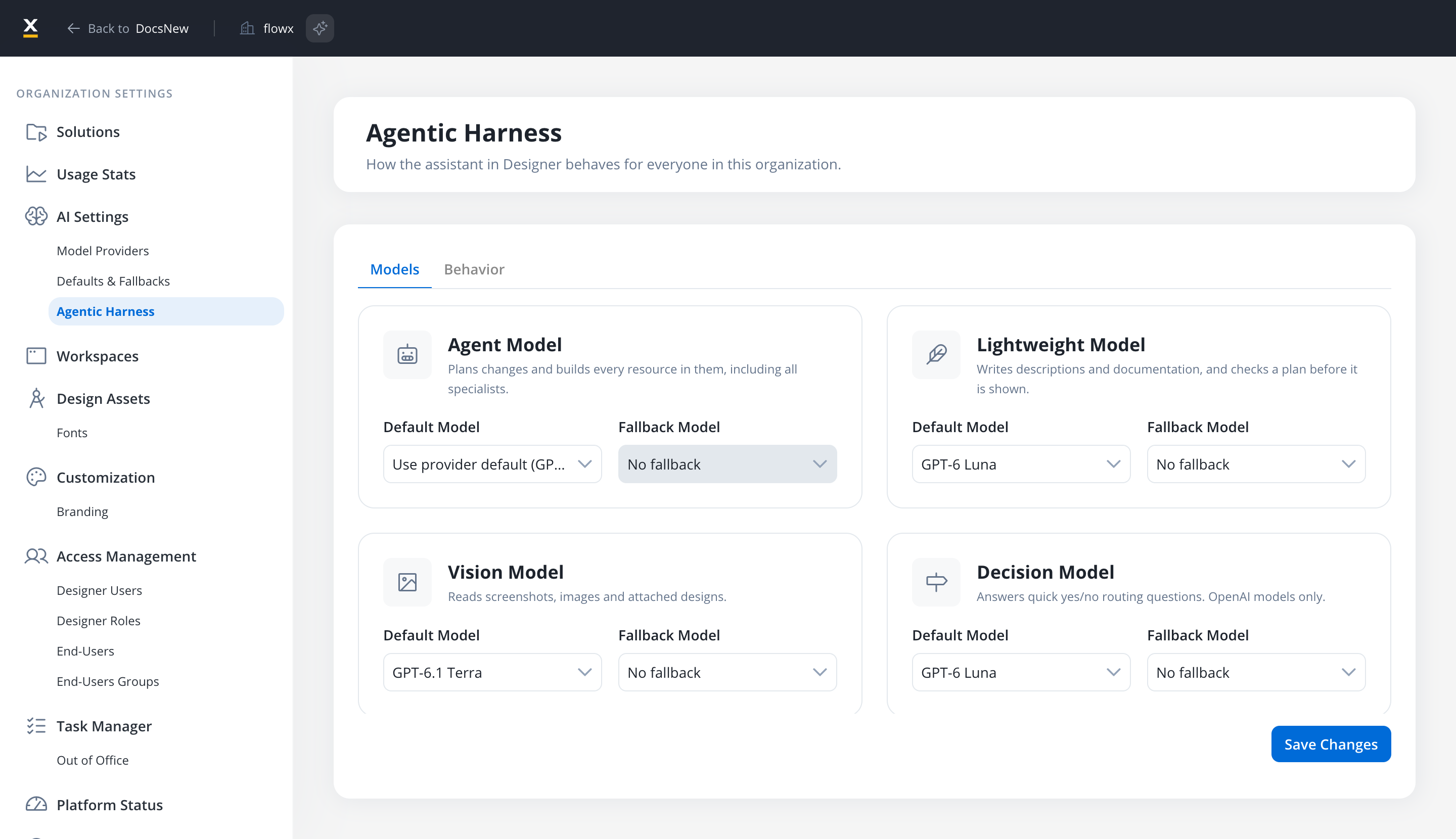
The **Agentic Harness** page sets which models the harness uses and how it behaves for everyone in the organization. To open it, select your avatar at the top right of the Designer, select **Organization settings**, then go to **AI Settings** > **Agentic Harness**.
The page needs `org_ai_providers_read` to open and `org_ai_providers_edit` to change it. Without edit permission, **Save Changes** is hidden. The page is listed only when the harness is available on your installation.
It has two tabs, **Models** and **Behavior**. **Save Changes** saves both. If someone else saved the page after you opened it, your save is refused and the page reloads their settings: apply your changes again and save.
### Models
Each card has a **Default Model** and a **Fallback Model** for one part of the harness's work:
| Model | What it does | When no default is chosen |
| - | - | - |
| **Agent Model** | Plans changes and builds every resource in them, including all specialists. | **Use provider default**, naming the model it resolves to |
| **Lightweight Model** | Writes descriptions and documentation, and checks a plan before it is shown. | The provider default when there is one, otherwise **Same as agent model** |
| **Vision Model** | Reads screenshots, images and attached designs. | The provider default when there is one, otherwise **None** |
| **Decision Model** | Answers quick yes/no routing questions. | The provider default when there is one, otherwise **None** |
* **Fallback Model** is available only after you choose a default model on that card, and it must be a different model.
* **Decision Model** accepts OpenAI models only.
* When an installation can't run a lightweight model, the **Lightweight Model** card is unavailable and says so.
These choices apply only to the harness. Business agents and AI nodes in your apps use the assignments on **Defaults & Fallbacks**. See [AI providers](https://docs.flowx.ai/6.x/ai-platform/ai-providers.md).
### Behavior
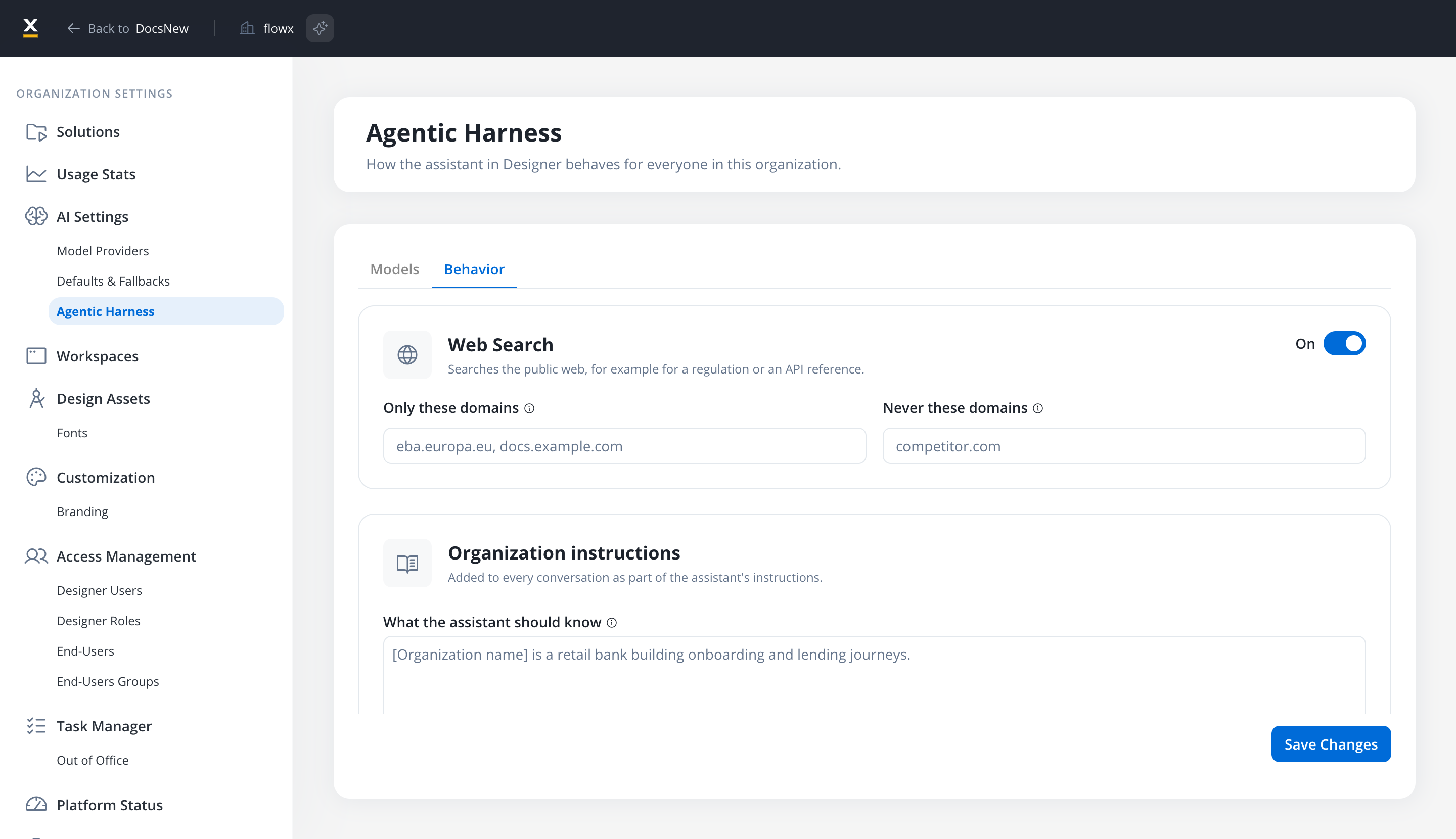
* **Web Search** lets the harness search the public web, for example for a regulation or an API reference. Turn it **On** or **Off**. When web search isn't available on your installation, the card says so.
* **Only these domains** limits searches to the domains you list. Leave it empty to allow any domain.
* **Never these domains** blocks domains. A blocked domain also blocks pages inside an allowed one.
* Each list takes up to 200 domains.
* **Organization instructions** adds the text you enter in **What the assistant should know** to every conversation, as part of the assistant's instructions. Use it for context every conversation needs, such as what your organization builds. It takes up to 10,000 characters.
***
## Related resources
The Developer Agentic Harness builds and changes your app for you in the Designer. To create AI agents that run inside your apps and serve your users, use [Agent Builder](https://docs.flowx.ai/6.x/ai-platform/agent-builder/overview.md) instead.
> [card] [AI in FlowX](https://docs.flowx.ai/6.x/ai-platform/ai-in-flowx.md)
>
> Overview of config-time and business agents
> [card] [Agent Builder](https://docs.flowx.ai/6.x/ai-platform/agent-builder/overview.md)
>
> Build business agents that run inside your apps
> [card] [Versioning](https://docs.flowx.ai/6.x/docs/projects/managing-applications/versioning.md)
>
> Branches, commits, merging, and builds
## Related topics
- [FlowX.AI 5.13.0 Release Notes](https://docs.flowx.ai/release-notes/v5.x/v5.13.0-september-2026/v5.13.0-september-2026.md)
- [FlowX.AI 6.0.0 Release Notes](https://docs.flowx.ai/release-notes/v6.x/v6.0.0-october-2026/v6.0.0-october-2026.md)
- [Agent Builder](https://docs.flowx.ai/6.x/ai-platform/agent-builder/overview.md)
- [AI in FlowX](https://docs.flowx.ai/6.x/ai-platform/ai-in-flowx.md)
- [Using AI agents](https://docs.flowx.ai/6.x/ai-platform/using-agents/overview.md)
This documentation is built and hosted on [Mintlify](https://mintlify.com), a developer documentation platform.