> ## Documentation Index
> Fetch the complete documentation index at: https://docs.flowx.ai/llms.txt
> Use this file to discover all available pages before exploring further.
# Deployment guidelines v5.9.0
> Component versions, environment variables, and configuration changes for FlowX.AI 5.9.0 deployments.
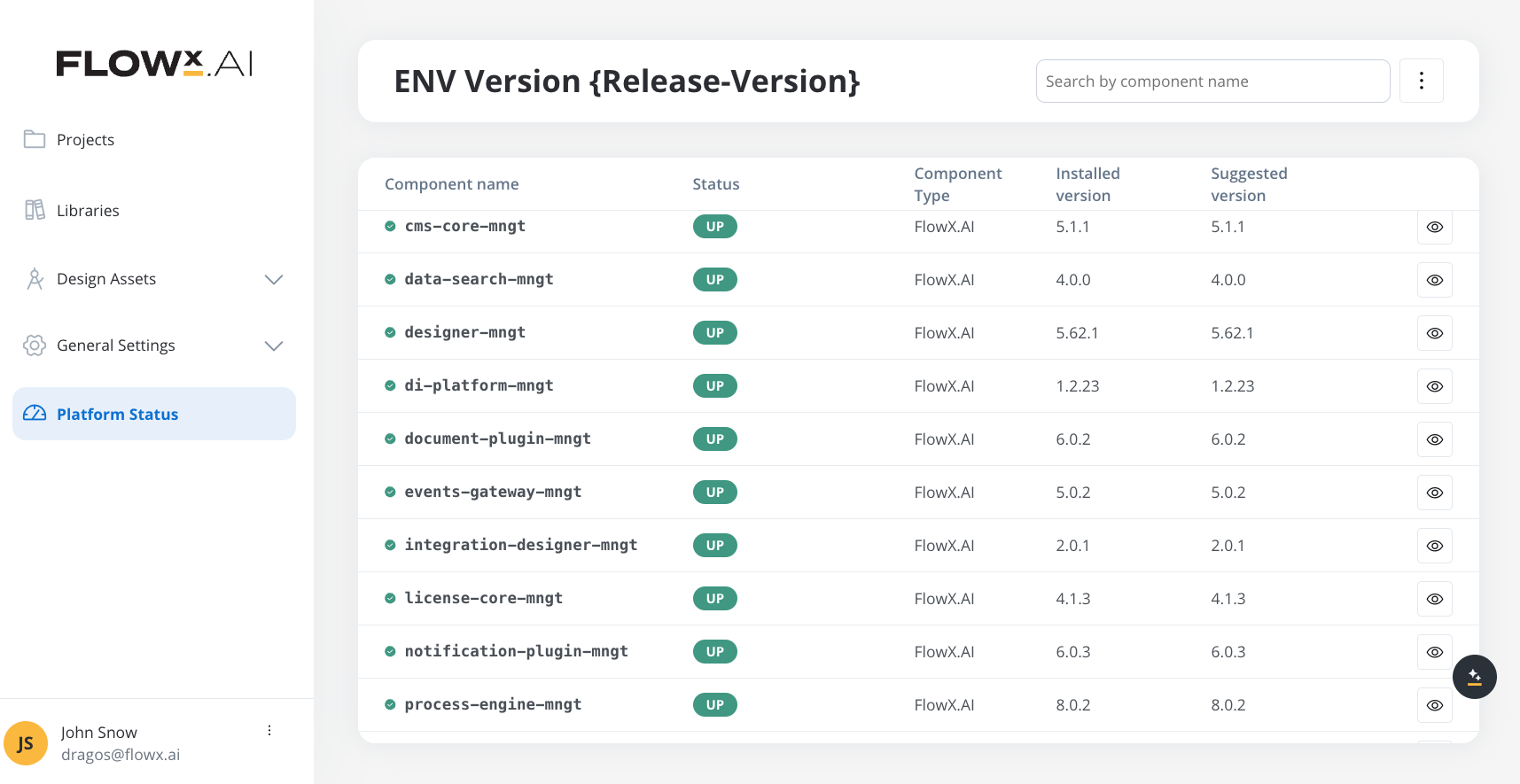
After upgrading to a new platform version, always ensure that your installed component versions match the versions specified in the release notes. To verify this, navigate to **FlowX.AI Designer > Platform Status**.
**Upgrading from 5.1.x LTS?** This page describes the steady-state 5.9.0 deployment. For the architecture delta, deprecation list, and upgrade steps, see [Migrating from 5.1 LTS](/5.9/migrating-from-5.1-lts/overview).
**Deployment packaging.** 5.9.x is the last LTS release distributed as a multi-chart deployment, where each FlowX service is installed from its own Helm chart.
## Component versions
The following tables list component versions per FlowX.AI release. Verify your installed versions against the 5.9.0 column in **FlowX.AI Designer → Platform Status**.
| Component | 5.9.0 | 5.8.0 | 5.7.0 | 5.6.0 | 5.5.0 | 5.4.0 |
| -------------------------- | -------- | -------- | -------- | -------- | ------- | ------- |
| **process-engine** | 10.135.0 | 10.106.0 | 10.96.0 | 10.77.0 | 10.60.0 | 10.38.0 |
| **admin** | 10.116.0 | 10.93.0 | 10.83.0 | 10.66.0 | 10.53.0 | 10.38.0 |
| **designer** | 10.230.2 | 10.181.0 | 10.164.0 | 10.127.3 | 10.91.0 | 10.59.1 |
| **cms-core** | 10.86.0 | 10.67.0 | 10.58.0 | 10.43.0 | 10.35.0 | 10.22.0 |
| **scheduler-core** | 10.70.0 | 10.53.0 | 10.45.0 | 10.31.0 | 10.25.0 | 10.15.0 |
| **events-gateway** | 10.72.0 | 10.55.0 | 10.47.0 | 10.33.1 | 10.27.0 | 10.17.0 |
| **notification-plugin** | 10.83.0 | 10.64.0 | 10.56.0 | 10.42.1 | 10.35.0 | 10.22.0 |
| **document-plugin** | 10.94.0 | 10.75.0 | 10.64.0 | 10.46.0 | 10.35.0 | 10.23.0 |
| **task-management-plugin** | 10.84.0 | 10.66.0 | 10.57.0 | 10.41.1 | 10.35.0 | 10.25.0 |
| **data-search** | 10.69.0 | 10.52.0 | 10.44.0 | 10.30.1 | 10.25.0 | 10.14.0 |
| **audit-core** | 10.79.0 | 10.63.0 | 10.54.0 | 10.40.0 | 10.31.0 | 10.21.0 |
| **advancing-controller** | 10.73.0 | 10.55.0 | 10.45.0 | 10.33.1 | 10.27.0 | 10.16.0 |
| **integration-designer** | 10.162.0 | 10.128.0 | 10.113.0 | 10.84.0 | 10.63.0 | 10.38.0 |
| **application-manager** | 10.123.0 | 10.97.0 | 10.88.0 | 10.69.1 | 10.53.0 | 10.37.0 |
| **runtime-manager** | 10.123.0 | 10.97.0 | 10.88.0 | 10.69.1 | 10.53.0 | 10.37.0 |
| **data-sync** | 10.81.0 | 10.58.0 | 10.50.0 | 10.38.0 | 10.31.1 | 10.20.1 |
| **authorization-system** | 10.96.1 | 10.77.0 | 10.68.0 | 10.51.0 | 10.42.1 | 10.28.0 |
| **nosql-db-runner** | 10.75.0 | 10.56.0 | 10.48.0 | 10.34.0 | 10.27.0 | 10.17.0 |
| **email-gateway** | 10.74.0 | 10.56.0 | 10.47.0 | 10.32.1 | 10.24.0 | 10.9.0 |
| **organization-manager** | 10.71.0 | 10.53.0 | 10.44.0 | 10.26.1 | 10.19.2 | - |
| **webhook-gateway** | 10.44.0 | 10.25.0 | 10.15.0 | 10.1.1 | - | - |
| **file-gateway** | 10.8.0 | - | - | - | - | - |
| **license** | 10.63.0 | 10.46.0 | 10.36.0 | - | - | - |
### Embedded components
* **SpiceDB**
* **Qdrant** (vector database) — bundled in the AI Platform Helm chart; its version is managed by the chart and not pinned here. See the [Qdrant setup guide](/5.9/setup-guides/qdrant) for deployment and configuration.
### Renderers
| Component | 5.9.0 | 5.8.0 | 5.7.0 | 5.6.0 | 5.5.0 | 5.4.0 |
| ---------------------------------- | -------- | -------- | -------- | -------- | ------- | ------- |
| **@flowx/angular-sdk** | 10.230.2 | 10.181.0 | 10.164.0 | 10.127.3 | 10.68.0 | 10.59.1 |
| **@flowx/angular-theme** | 10.230.2 | 10.181.0 | 10.164.0 | 10.127.3 | 10.68.0 | 10.59.1 |
| **@flowx/angular-ui-toolkit** | 10.230.2 | 10.181.0 | 10.164.0 | 10.127.3 | 10.68.0 | 10.59.1 |
| **@flowx/react-sdk** | 10.230.2 | 10.181.0 | 10.164.0 | 10.127.3 | 10.68.0 | 10.59.1 |
| **@flowx/react-theme** | 10.230.2 | 10.181.0 | 10.164.0 | 10.127.3 | 10.68.0 | 10.59.1 |
| **@flowx/react-ui-toolkit** | 10.230.2 | 10.181.0 | 10.164.0 | 10.127.3 | 10.68.0 | 10.59.1 |
| **@flowx/react-native-sdk** | 10.230.2 | - | - | - | - | - |
| **@flowx/react-native-theme** | 10.230.2 | - | - | - | - | - |
| **@flowx/react-native-ui-toolkit** | 10.230.2 | - | - | - | - | - |
| **@flowx/core-sdk** | 10.230.2 | 10.181.0 | 10.164.0 | 10.127.3 | 10.68.0 | 10.59.1 |
| **@flowx/core-theme** | 10.230.2 | 10.181.0 | 10.164.0 | 10.127.3 | 10.68.0 | 10.59.1 |
| **react-saas** | 10.230.2 | - | - | - | - | - |
| **iOS renderer** | 10.4.1 | 10.3.0 | 10.3.0 | 10.3.0 | 10.3.0 | 10.2.0 |
| **Android renderer** | 10.5.0 | 10.3.0 | 10.3.0 | 10.3.0 | 10.3.0 | 10.2.0 |
The **react-saas** container app tracks the designer version.
### Plugins
| Component | 5.9.0 | 5.8.0 | 5.7.0 | 5.6.0 | 5.5.0 | 5.4.0 |
| -------------------- | ------ | ------ | ------ | ------ | ------ | ------ |
| **ocr-plugin** | 1.0.19 | 1.0.17 | 1.0.17 | 1.0.17 | 1.0.17 | 1.0.17 |
| **reporting-plugin** | 0.2.6 | 0.2.3 | 0.2.3 | 0.2.3 | 0.2.3 | 0.2.3 |
### AI components
FlowX.AI groups AI services into four tiers by deployment role. **AI Base** components are the foundation; **AI Runtime** and **AI Dev Time** components both require Base to be installed first; **AI Extensions** are optional add-ons layered on top.
#### AI Base components
Foundation services. Install these before any Runtime or Dev Time component.
| Component | 5.9.0 | 5.8.0 | 5.7.0 | 5.6.0 | 5.5.0 | 5.4.0 |
| ---------------------------------------- | ------ | ------ | ------ | ------ | ------ | ----- |
| **ai-platform-knowledgebase-indexer-v2** | 10.7.0 | 10.7.0 | 10.6.2 | 10.6.0 | 10.2.0 | - |
| **ai-platform-knowledgebase-rag** | 10.7.0 | 10.7.0 | 10.6.2 | 10.6.0 | 10.2.0 | - |
| **ai-platform-embedder** | 10.7.0 | 10.7.0 | 10.6.2 | - | - | - |
| **doc-parser** | 10.9.0 | 10.7.0 | 10.6.2 | 10.5.1 | - | - |
#### AI Runtime components
Requires AI Base. Services that execute AI workloads at runtime.
| Component | 5.9.0 | 5.8.0 | 5.7.0 | 5.6.0 | 5.5.0 | 5.4.0 |
| ----------------------------- | ------ | ------ | ------ | ------ | ------ | ------ |
| **ai-platform-agent-builder** | 10.7.0 | 10.7.0 | 10.6.2 | 10.6.0 | 10.4.0 | 10.1.3 |
| **data-privacy** | 10.1.0 | 10.1.0 | 10.0.8 | - | - | - |
| **doc-converter** | 10.2.3 | 10.2.3 | 10.2.3 | 10.2.2 | - | - |
| **evals-judge** | 10.1.1 | - | - | - | - | - |
| **speech-to-text** | 10.3.4 | - | - | - | - | - |
| **web-crawler** | 10.3.5 | 10.3.5 | 10.3.2 | - | - | - |
#### AI Dev Time components
Requires AI Base. Services used at design time inside the Designer.
| Component | 5.9.0 | 5.8.0 | 5.7.0 | 5.6.0 | 5.5.0 | 5.4.0 |
| ---------------------------- | ------ | ------ | ------ | ------ | ------ | ------ |
| **ai-gateway** | 10.7.0 | - | - | - | - | - |
| **ai-platform-ai-analyst** | 10.7.0 | 10.7.0 | 10.6.2 | 10.6.0 | 10.4.0 | 10.1.3 |
| **ai-platform-ai-assistant** | 10.7.0 | 10.7.0 | 10.6.2 | - | - | - |
| **ai-platform-ai-designer** | 10.7.0 | 10.7.0 | 10.6.2 | 10.6.0 | 10.4.0 | 10.1.3 |
| **ai-platform-ai-developer** | 10.7.0 | 10.7.0 | 10.6.2 | 10.6.0 | 10.4.0 | 10.1.3 |
| **ai-platform-planner** | 10.7.0 | 10.7.0 | 10.6.2 | 10.6.0 | 10.4.0 | 10.1.3 |
| **di-platform** | 10.3.1 | 10.3.0 | 10.3.0 | 10.3.0 | 10.2.6 | 10.2.5 |
| **flowx-docs** | 5.9.0 | - | - | - | - | - |
#### AI Extensions
Optional add-ons layered on the AI Platform.
| Component | 5.9.0 | 5.8.0 | 5.7.0 | 5.6.0 | 5.5.0 | 5.4.0 |
| ------------------ | ------ | ------ | ------ | ----- | ----- | ----- |
| **modpod** | 10.0.7 | 10.0.7 | 10.0.7 | - | - | - |
| **ai-observatory** | 10.3.2 | - | - | - | - | - |
***
## Third-party supported component versions
Within each version line listed below, versions that have reached upstream end of life are not supported, even though their major/minor is listed.
| FlowX.AI Version | 3rd Party Dependency | Supported Versions |
| ---------------- | --------------------------------- | ------------------ |
| 5.9.x | Keycloak | 26 |
| 5.9.x | Kafka | 3.9, 4.0, 4.1, 4.2 |
| 5.9.x | PostgreSQL | 16, 17, 18 |
| 5.9.x | Oracle Database | 21c, 23ai |
| 5.9.x | MongoDB | 7, 8 |
| 5.9.x | Redis | 7, 8 |
| 5.9.x | Elasticsearch | 8, 9 |
| 5.9.x | Elasticsearch Sink Connector (\*) | 15 |
| 5.9.x | Angular (Web SDK) | 20.3 |
| 5.9.x | React (Web SDK) | 19 |
(\*) Required only if using indexing via Kafka. Multiple sink connector implementations also work, as long as they are compatible with both the deployed Kafka and Elasticsearch version.
The table lists version lines, not individual versions. A version is supported for as long as its vendor still supports it, so check the version you plan to deploy against that vendor's lifecycle page before committing to it. When a version reaches upstream end of life it is no longer supported; upgrade that component to keep your deployment on a supported configuration. Versions can also be added during the family's lifetime as FlowX validates them.
***
## Kafka topics
### Document-plugin archive and extract listeners
5.9.0 exposes four Kafka topics for the document-plugin **archive** and **extract** operations. Both follow the encrypt/decrypt trigger and reply pattern: document-plugin consumes the `trigger.*.file` topic and process-engine consumes the matching `engine.receive.*.file.results` reply.
| Topic | Producer | Consumer |
| ----------------------------------------------------------------- | --------------- | --------------- |
| `ai.flowx.plugin.document.trigger.archive.file.v1` | process-engine | document-plugin |
| `ai.flowx.engine.receive.plugin.document.archive.file.results.v1` | document-plugin | process-engine |
| `ai.flowx.plugin.document.trigger.extract.file.v1` | process-engine | document-plugin |
| `ai.flowx.engine.receive.plugin.document.extract.file.results.v1` | document-plugin | process-engine |
The four topic names are exposed as env vars on the document-plugin side (`KAFKA_TOPIC_FILE_ARCHIVE_IN`, `KAFKA_TOPIC_FILE_ARCHIVE_OUT`, `KAFKA_TOPIC_FILE_EXTRACT_IN`, `KAFKA_TOPIC_FILE_EXTRACT_OUT`). See [Documents plugin setup → File archive / File extract](/5.9/setup-guides/documents-plugin-setup#file-archive). Two new thread-pool entries are added: `KAFKA_CONSUMER_THREADPOOLS_THREADPOOLGENERIC_THREADCOUNTPERCONTAINER_FILEARCHIVEIN` and `..._FILEEXTRACTIN`, both defaulting to `5`.
### Document-plugin encrypt and decrypt listeners
The **encrypt** and **decrypt** operations follow the same trigger-and-reply pattern: process-engine produces the `trigger.*.file` topic and document-plugin replies on the matching `engine.receive.*.file.results` topic.
| Topic | Producer | Consumer |
| ----------------------------------------------------------------- | --------------- | --------------- |
| `ai.flowx.plugin.document.trigger.encrypt.file.v1` | process-engine | document-plugin |
| `ai.flowx.engine.receive.plugin.document.encrypt.file.results.v1` | document-plugin | process-engine |
| `ai.flowx.plugin.document.trigger.decrypt.file.v1` | process-engine | document-plugin |
| `ai.flowx.engine.receive.plugin.document.decrypt.file.results.v1` | document-plugin | process-engine |
The topic names are exposed as env vars on the document-plugin side: `KAFKA_TOPIC_FILE_ENCRYPT_IN`, `KAFKA_TOPIC_FILE_ENCRYPT_OUT`, `KAFKA_TOPIC_FILE_DECRYPT_IN`, `KAFKA_TOPIC_FILE_DECRYPT_OUT`.
### Document-plugin session-upload listeners
Multi-file upload for UI flows routes uploaded files to the document-plugin for persistence. process-engine produces the trigger topic and document-plugin consumes it — `session` for a single upload session and `session.bulk` for batched multi-file uploads.
| Topic | Producer | Consumer |
| ------------------------------------------------------------------- | -------------- | --------------- |
| `ai.flowx.plugin.document.trigger.persist.document.session.v1` | process-engine | document-plugin |
| `ai.flowx.plugin.document.trigger.persist.document.session.bulk.v1` | process-engine | document-plugin |
The topic names are exposed on process-engine as `KAFKA_TOPIC_SESSION_UPLOAD_OUT` and `KAFKA_TOPIC_SESSION_UPLOAD_BULK_OUT`, and on document-plugin as `KAFKA_TOPIC_DOCUMENT_PERSIST_SESSION_IN` and `KAFKA_TOPIC_DOCUMENT_PERSIST_SESSION_BULK_IN`.
### AI Platform job topics
`integration-designer` dispatches asynchronous jobs to the standalone AI services over Kafka, using a request/response pair per service. Provision these topics when you deploy the corresponding AI service (see [AI components](#ai-components) above).
| Topic | Producer | Consumer |
| ----------------------------------------------------- | -------------------- | -------------------- |
| `ai.flowx.ai-platform.doc-parser.job.request.v1` | integration-designer | doc-parser |
| `ai.flowx.ai-platform.doc-parser.job.response.v1` | doc-parser | integration-designer |
| `ai.flowx.ai-platform.evals-judge.job.request.v1` | integration-designer | evals-judge |
| `ai.flowx.ai-platform.evals-judge.job.response.v1` | evals-judge | integration-designer |
| `ai.flowx.ai-platform.speech-to-text.job.request.v1` | integration-designer | speech-to-text |
| `ai.flowx.ai-platform.speech-to-text.job.response.v1` | speech-to-text | integration-designer |
On `integration-designer` the topic names are set via `KAFKA_TOPIC_AI__JOB_REQUEST_OUT` and `..._RESPONSE_IN` (for example `KAFKA_TOPIC_AI_EVALSJUDGE_JOB_REQUEST_OUT`). Each service also has a dead-letter topic — `ai.flowx.ai-platform..job.dlq.v1`, set via `KAFKA_TOPIC_AI__JOB_DLQ_IN` — that integration-designer consumes for failed jobs.
### UI Flow runtime triggers
process-engine consumes two trigger topics that back the UI Flow runtime cache and expiration features. `update` invalidates a cached UI Flow when its definition changes; `expire` removes expired UI Flow runtime data.
| Topic | Producer | Consumer |
| ----------------------------------------- | ------------------------------------- | -------------- |
| `ai.flowx.core.trigger.ui-flow.update.v1` | document-plugin, integration-designer | process-engine |
| `ai.flowx.core.trigger.expire.ui-flow.v1` | scheduler-core | process-engine |
On process-engine these are set via `KAFKA_TOPIC_UIFLOW_UPDATE_IN` and `KAFKA_TOPIC_UIFLOW_EXPIRE_IN`; the producers expose `KAFKA_TOPIC_UIFLOW_UPDATE_OUT`. The expire trigger uses the platform scheduler: when a UI Flow session is created, process-engine registers a delayed message with scheduler-core, which publishes it back to this topic at the expiry time. It is consumed by a dedicated consumer group (`KAFKA_CONSUMER_GROUPID_PROCESS_UIFLOWEXPIRE`, default `ui-flow-expire`).
### File and webhook process triggers
Two trigger topics let the file-gateway and webhook-gateway start or resume processes in process-engine. The **start-for-event** topic starts a process when a watched file arrives (file-gateway) or an incoming webhook fires (webhook-gateway); the **message event** topic resumes a running process that is waiting on an intermediate message catch event.
| Topic | Producer | Consumer |
| -------------------------------------------------- | ----------------------------- | -------------- |
| `ai.flowx.core.trigger.start-for-event.process.v1` | file-gateway, webhook-gateway | process-engine |
| `ai.flowx.core.message.event.process.v1` | webhook-gateway | process-engine |
On the producers, the start-for-event topic is set via `KAFKA_TOPIC_TRIGGER_STARTFOREVENT_PROCESS_OUT` (file-gateway) and `KAFKA_TOPIC_PROCESS_START_OUT` (webhook-gateway); process-engine consumes it via `KAFKA_TOPIC_PROCESS_STARTFOREVENT_IN`. The message event topic uses `KAFKA_TOPIC_PROCESS_EVENT_MESSAGE` on both webhook-gateway and process-engine. Like every service, file-gateway and webhook-gateway also publish to the shared audit topic `ai.flowx.core.trigger.save.audit.v1` via `KAFKA_TOPIC_AUDIT_OUT` (consumed by audit-core).
***
## Environment variables
**A configuration that blocks startup is a required configuration.** If a service fails to start and its logs report a missing or empty configuration value, treat that value as required and provide it, even when it is not flagged as required here. These guides document the most common variables; they are not an exhaustive list of every value your deployment topology requires.
### Data-sync: Keycloak admin credentials
The data-sync job provisions FlowX-managed end-user groups and runtime roles in Keycloak on first run, using the Keycloak admin API. Configure the following on the data-sync job:
| Environment Variable | Description | Default Value | Component |
| ------------------------ | ----------------------------------------------------------------------------------------------------------------------------------------------------------- | ------------- | --------- |
| `FLOWX_OPENID_PROVIDER` | OpenID provider type. Set to `keycloak` (the only supported provider). | `keycloak` | data-sync |
| `FLOWX_OPENID_SERVERURL` | Base URL of the Keycloak server, including the `/auth/` path. | `-` | data-sync |
| `FLOWX_OPENID_USER` | Username of a Keycloak admin account that can manage groups and roles in the FlowX realm. | `-` | data-sync |
| `FLOWX_OPENID_PASSWORD` | Password for the admin account above. Store in a Kubernetes Secret. | `-` | data-sync |
| `FLOWX_OPENID_CLIENTID` | Keycloak admin client used to obtain the admin token. Typically `admin-cli` for standard Keycloak deployments. Must be set explicitly. There is no default. | `-` | data-sync |
For full data-sync configuration, see [Data-sync job setup](/5.9/setup-guides/data-sync#openid-provider-configuration).
### Anonymous service account: shared client secret
5.9.x introduces a single shared service-account client, `flowx-anonymous-sa`, used by FlowX backend services for inter-service calls on anonymous (unauthenticated) runtime flows. One client secret is reused across all consumers — it must be provided in two places.
**On `authorization-system`** — passed to Liquibase so the client is provisioned with the correct secret when FlowX manages Keycloak:
| Environment Variable | Description | Default Value | Component |
| ---------------------------------------------------------------------- | -------------------------------------------------------------------------------------------------------------------------------------------------------------------------- | ------------- | ---------------------- |
| `SPRING_LIQUIBASE_PARAMETERS_SECRETS_SERVICEACCOUNTS_FLOWXANONYMOUSSA` | Client secret used by Liquibase to create the `flowx-anonymous-sa` client in the service-accounts realm at first boot. Required when `SECURITY_KEYCLOAKADMINENABLED=true`. | `-` | `authorization-system` |
**On every consuming service** — the Spring Security OAuth2 client registration for the `anonymousidentity` alias resolves the same secret at runtime:
| Environment Variable | Description | Default Value | Component |
| --------------------------------------------------------------------------- | ------------------------------------------------------------------------------------------------------------------------------------------------ | ------------- | ---------------------------------------------------------------------------------------------------------------------------------------------------------------------------------------------------------------------------------------------------------------------------------------------------------- |
| `SPRING_SECURITY_OAUTH2_CLIENT_REGISTRATION_ANONYMOUSIDENTITY_CLIENTSECRET` | Client secret for the `anonymousidentity` registration. **Must be the same value across every service** — it is a single shared service account. | `-` | `admin`, `application-manager`, `authorization-system`, `document-plugin`, `email-gateway`, `events-gateway`, `file-gateway`, `integration-designer`, `license`, `mock-server`, `nosql-db-runner`, `organization-manager`, `process-engine`, `scheduler-core`, `task-management-plugin`, `webhook-gateway` |
This is a secret. Store it in your secrets management solution (e.g., Kubernetes Secret, Vault) and reference it from there. Never commit it to version control.
For the Keycloak-side context (`flowx-anonymous-sa` client, `SA_FLOWX_ANONYMOUS` realm role, manual-configuration recipe for deployments without Keycloak admin access), see [Manual Keycloak configuration](/5.9/setup-guides/access-management/configuring-an-iam-solution#manual-keycloak-configuration).
### Knowledgebase-rag: Qdrant search tuning
Two env vars control the fanout of dense and sparse Qdrant queries inside the `knowledgebase-rag` service. Defaults are tunable per environment.
| Environment Variable | Description | Default Value | Component |
| ----------------------- | ---------------------------------------------------------------------------------------------------------------------------- | ------------- | ----------------- |
| `QDRANT_PREFETCH_LIMIT` | Maximum points returned by each dense/sparse prefetch stage in a hybrid search before fusion. | `100` | knowledgebase-rag |
| `QDRANT_FUSION_LIMIT` | Maximum points returned after RRF fusion (hybrid search) or by a single-stage dense/keyword search. Caps the reranker input. | `80` | knowledgebase-rag |
Raise both when recall is insufficient on very large or long-tailed Knowledge Bases. Lower them when Qdrant pods report memory pressure or filter-heavy queries time out.
### CORS handling: `APPLICATION_CORS_ALLOWORIGIN`
CORS is enforced at the application layer. Each backend service exposed via admin or public URLs reads its allowed-origin list from a single environment variable. Allowed methods, allowed headers, exposed headers, and credential handling are baked into each service's `application.yaml` with safe defaults. The 5.9.x default allow-headers set is `Accept, Content-Type, Authorization, Fx-Workspace-Id, Fx-Client-Host, Referer, User-Agent, Flowx-Platform, X-Fx-Anonymous-Session-Id, Fx-BuildId, Fx-AppId`, and `X-Fx-Anonymous-Session-Id` is exposed to the browser for anonymous runtime sessions. Only `APPLICATION_CORS_ALLOWORIGIN` is deployment-specific.
| Environment Variable | Description | Default Value | Component |
| --------------------------------- | --------------------------------------------------------------------------------------------------------------------------------------------------------------------------------------------------------------------------------------- | --------------------------- | ----------------------------------------------------------------------------------------------------------------------------------------------------------------------------------------------------------------------------------------------------------------------------------------------------------------------- |
| `APPLICATION_CORS_ALLOWORIGIN` | Comma-separated list of origins allowed to call this service from the browser. Supports wildcard subdomains (`https://*.yourcompany.com`). Must include every Designer, runtime renderer, and integration domain that calls FlowX APIs. | `-` | `admin`, `ai-gateway`, `application-manager`, `audit-core`, `authorization-system`, `cms-core`, `document-plugin`, `events-gateway`, `file-gateway`, `integration-designer`, `license`, `notification-plugin`, `organization-manager`, `process-engine`, `runtime-manager`, `task-management-plugin`, `webhook-gateway` |
| `APPLICATION_CORS_EXPOSEDHEADERS` | Response headers exposed to browser JavaScript. The default carries the anonymous-session header; override only if you need to expose additional custom headers. | `X-Fx-Anonymous-Session-Id` | all services (shared security library) |
For migration guidance and the full list of removed NGINX CORS annotations, see [Ingress routing and CORS](/5.9/migrating-from-5.1-lts/ingress-routing).
### Process-engine and integration-designer: native script engine
The default script engine for JavaScript and Python execution is a **native subprocess pool**. Scripts run in isolated Node.js and Python worker processes.
| Environment Variable | Description | Default Value | Component |
| --------------------------------------------------------------------- | ------------------------------------------------- | ------------------ | ------------------------------------ |
| `APPLICATION_SCRIPTENGINE_PROVIDER` | Script engine provider | `native` | process-engine, integration-designer |
| `APPLICATION_SCRIPTENGINE_NATIVEENGINE_JS_POOLSIZE` | Node.js worker pool size | `16` | process-engine, integration-designer |
| `APPLICATION_SCRIPTENGINE_NATIVEENGINE_JS_EXECUTABLE` | Path to the Node.js binary | `/usr/bin/node` | process-engine, integration-designer |
| `APPLICATION_SCRIPTENGINE_NATIVEENGINE_JS_EXECUTIONTIMEOUTMS` | JS script execution timeout (ms) | `5000` | process-engine, integration-designer |
| `APPLICATION_SCRIPTENGINE_NATIVEENGINE_JS_MAXEXECUTIONSPERWORKER` | Max executions before a JS worker is recycled | `10000` | process-engine, integration-designer |
| `APPLICATION_SCRIPTENGINE_NATIVEENGINE_JS_MAXPAYLOADSIZEBYTES` | Max JS input payload size (bytes) | `1048576` | process-engine, integration-designer |
| `APPLICATION_SCRIPTENGINE_NATIVEENGINE_PYTHON_POOLSIZE` | Python worker pool size | `8` | process-engine, integration-designer |
| `APPLICATION_SCRIPTENGINE_NATIVEENGINE_PYTHON_EXECUTABLE` | Path to the Python 3 binary | `/usr/bin/python3` | process-engine, integration-designer |
| `APPLICATION_SCRIPTENGINE_NATIVEENGINE_PYTHON_EXECUTIONTIMEOUTMS` | Python script execution timeout (ms) | `10000` | process-engine, integration-designer |
| `APPLICATION_SCRIPTENGINE_NATIVEENGINE_PYTHON_MAXEXECUTIONSPERWORKER` | Max executions before a Python worker is recycled | `10000` | process-engine, integration-designer |
| `APPLICATION_SCRIPTENGINE_NATIVEENGINE_PYTHON_MAXPAYLOADSIZEBYTES` | Max Python input payload size (bytes) | `1048576` | process-engine, integration-designer |
To use GraalVM instead of the native engine, set `APPLICATION_SCRIPTENGINE_PROVIDER=graalvm` on both services.
## Related topics
- [FlowX.AI 5.9.0 Release Notes](/release-notes/v5.x/v5.9.0-june-2026/v5.9.0-june-2026.md)
- [Deployment guidelines v5.6.0](/release-notes/v5.x/v5.6.0-march-2026/deployment-guidelines-v5.6.md)
- [Deployment guidelines v5.3.0](/release-notes/v5.x/v5.3.0-december-2025/deployment-guidelines-v5.3.md)
- [Deployment guidelines v5.4.0](/release-notes/v5.x/v5.4.0-january-2026/deployment-guidelines-v5.4.md)
- [Deployment guidelines v5.5.0](/release-notes/v5.x/v5.5.0-february-2026/deployment-guidelines-v5.5.md)