

After upgrading to a new platform version, always ensure that your installed component versions match the versions specified in the release notes. To verify this, navigate to FlowX.AI Designer > Platform Status.
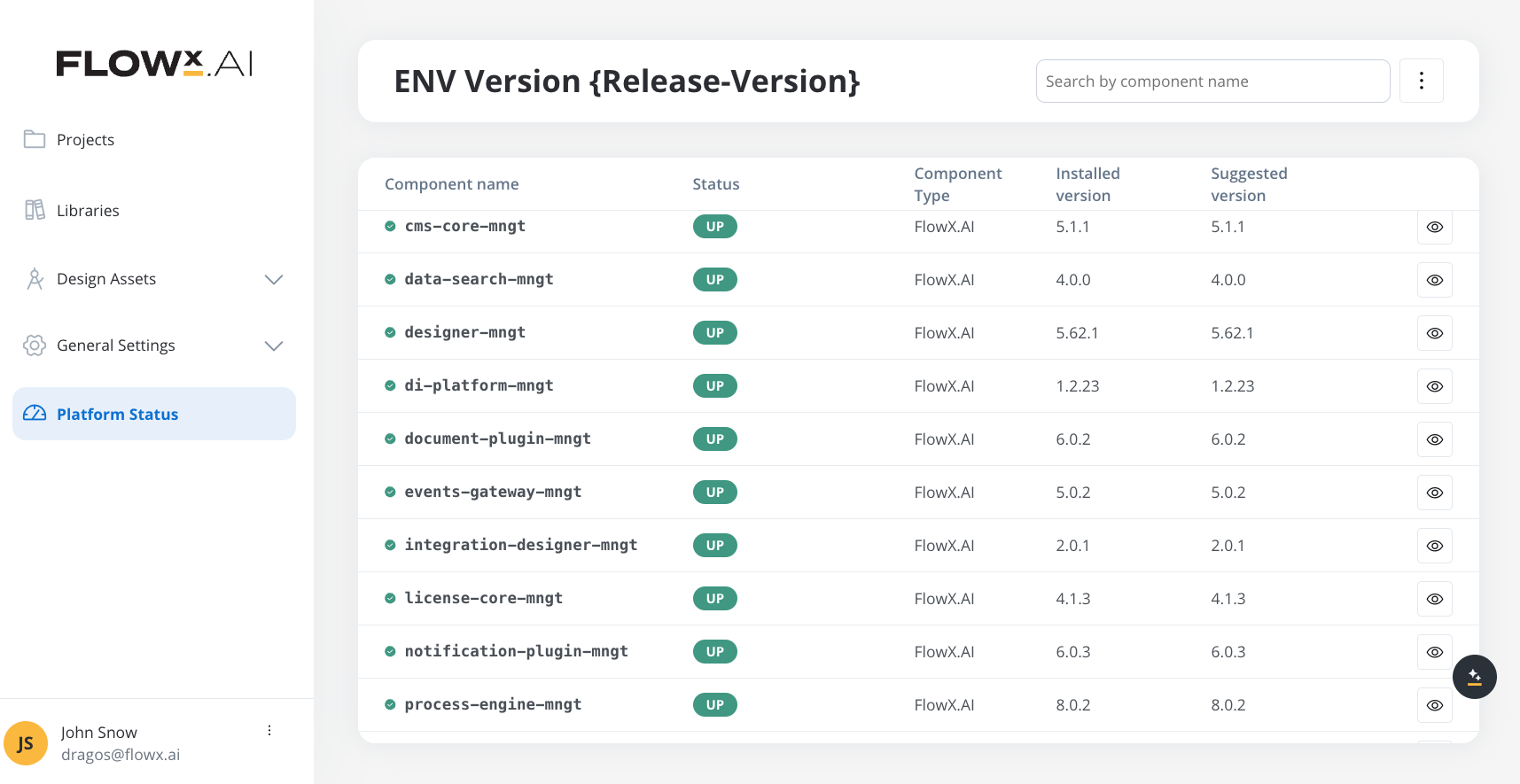
Component versions
Embedded components
- SpiceDB
- DGraph
Renderers
Plugins
AI Platform
Third-party supported component versions
Self-hosted deployment changes
Supported upgrade paths
Kafka integration changes
New Kafka topics
License lifecycle events are delivered from FlowX SaaS to the on-prem license service.
Custom-component correction requests complement the existing process / business-rule / reusable-template / ui-flow correction topics that the admin orchestrator already consumed.
UI Flow multi-file upload sends a single bulk command to document-plugin in place of the per-file pattern. The plugin persists each file in the session, emits one SSE frame (
UI_FLOW_FILE_UPLOAD_MULTIPLE, namespace = uploadBatchId) at the end of the batch via events-gateway, and forwards per-file results to the existing ai.flowx.core.trigger.ui-flow.update.v1 topic.
KB embedding-request / embedding-response replace the previous gRPC EmbedderService path (BulkGenerateEmbeddings / GenerateEmbeddings); the indexer now publishes one embedding job per chunk and the embedder writes points to Qdrant directly, emitting KbStoreEntryStateChanged once all chunks for an entry are persisted.
The two
core-services topic names (license.events, application-version.correction-after-app-operation.custom-component.request) resolve from the standard ${kafka.topic.naming.prefix} / ${kafka.topic.naming.suffix} machinery: default prefix ai.flowx. (empty environment segment), default suffix .v1. Operators that want an environment-prefixed topic name (e.g., ai.flowx.dev.license.events.v1) set kafka.topic.naming.environment globally rather than overriding individual topics. The two AI Platform topics are hard-coded constants in the indexer and embedder and do not participate in the prefix machinery.Environment variables
Environment variable names follow Spring relaxed binding conventions. For example, the YAML property
security.oauth2.sa-realm maps to the environment variable SECURITY_OAUTH2_SAREALM (dots become underscores, hyphens are removed, all uppercase).